

API headers are central to how your request is received by the target server - and the response it produces. These can be used to provide extra context for our request, prove our permission to access resources, or for other important metadata.
As such, knowing how to use request headers properly is a vital part of accessing external data via APIs.
Today, we鈥檙e going to cover everything you need to know - from what API headers are, what they do, and how they work - to concrete real-world examples of how you can leverage them to build integrated solutions.
We鈥檒l even see how 91制片厂 makes setting up API requests easier and more flexible than ever before.
First, though, let鈥檚 think about the basics.
What are API headers?
API headers are a section of your requests that鈥檚 used to transfer metadata about the request and the desired response.
In more basic terms, this is where you can provide extra information about the request.
API responses use HTTP request headers too - for exactly the same purposes - providing context to the data that鈥檚 been sent.
Header attributes can relate to several different things, but for the most part, we鈥檙e dealing with four categories of metadata.
These are:
- Information about the format of the request and response body.
- Authorization details.
- Response caching.
- Response cookies.
We鈥檒l check each of these out in a little bit more detail later.
For now, the important thing is to understand the relationship between the headers and the body of the API request or response.
The body is the actual data that you鈥檙e passing on or requesting. The header gives extra context to this request.
Why is this needed?
So why do we need REST API headers? If the body contains the data that we want to transfer with our request and response, what鈥檚 this extra information for?
Without getting into the technical stuff just yet, the metadata in your headers can play a few different roles.
The first is proving that we have the necessary permissions to perform the actions we鈥檙e requesting - whether this is querying a database or triggering some action in the target server.
We can also provide very basic information that鈥檚 helpful for server monitoring, like the DateTime of our request or details about the client we鈥檙e using to send it. These might be required by the server in order to get a valid response.
API headers also give us more control over how data is returned to us. For example, specifying a particular format for the response.
Finally, we might need to use headers simply because the server requires it - and we won鈥檛 get a response if we don鈥檛 meet the documented requirements.
Join 300,000 teams running operations on 91制片厂
What are API headers used for?
A minute ago, we saw that the information contained in request headers broadly falls into four categories.
Next, let鈥檚 check each of these out in turn to see the specific data we can include and what it does.
Body and response information
First, there鈥檚 additional information about our request body and the response - particularly relating to their format.
For request headers, some of the most common attributes are:
- Accept - For specifying the type of content that can be accepted in a response. For instance, application XML or JSON format.
- Content-type - For indicating the type of content that鈥檚 included in the request body.
- Accept-charset - For telling the server which character sets are acceptable to the client.
For response headers, the most common attributes here include:
- Allow - Denoting the types of requests that can be made by clients. For example, GET, Put, etc.
- Content-type - For indicating the type of content that鈥檚 included in the request body.
- Status - A response code that indicated whether the server successfully actioned the request - and if not, why.
Already, this gives both servers and clients a lot of flexibility within API calls. For example, we could specify that we need a response in a JSON object, but the server could throw a 406 error as its status - because this content type isn鈥檛 supported.
For more information on API bodies, take a look at our guide - what are the components of an API?
Authorization
Authorization is related to how we prove that we have permission to carry out specific actions. In other words, these API headers are used to safeguard security by preventing unauthorized access to server resources.
For the client side, the most common request header here is authorization, which is used to store your unique API key. This serves two roles. First, it proves that we鈥檙e allowed to make requests to the server.
Second, it can indicate to the server which specific resources user agents can access via API requests - at least within role-based access control systems.
The most common response header for authorization is www-authenticate. This indicates that some form of authentication is required before the server can respond to the original request.
Response caching
Response caching is when the server stores response data in order to reduce the number of requests that are made to the underlying dataset. This cuts the amount of work that鈥檚 required by the server to generate a response.
Basically, when a response is cached, the stored body is returned to requests, rather than the information being retrieved each time.
This is defined using the cache-control HTTP header.
We can use this to set a number of directives, such as:
- public - A cache can store the response.
- private - The response can be stored, but not in a shared cache.
- max-age - The time in seconds for which a cached response is acceptable.
- no-cache - Used by clients to specify that a stored response shouldn鈥檛 be used, or by the server shouldn鈥檛 use the response for subsequent requests without validation on the origin server.
- no-store - A cache must not store the request or response - if specified by the client or server respectively.
Response cookies
Finally, we have response cookies. These are small data objects that servers send to clients, which can then be stored and sent back in subsequent requests. This is particularly useful in user-facing contexts - for instance, browser-based applications.
This can be used for session management tasks, user tracking, personalization, or any other scenario where it鈥檚 useful to know that the same user has triggered several requests within a single session.
Servers can define cookies using the set-cookie attribute, and clients can send them back with the cookie header.
We can also add extra information to cookies if the server supports it - including expiration, security details, or other metadata.
Where can I find the headers in my API request
So, now we know what API headers are, how they work, and what they do. Let鈥檚 start to think about how they鈥檙e actually used.
The first question is where you can find them.
Now, to some extent, this is kind of an academic question. That is, most of the time we鈥檙e dealing with APIs in a dedicated API manager, or another purpose-built UI in a platform that can send API requests.
In this case, we鈥檒l be able to set them in the Headers section of whatever tool we鈥檙e using鈥檚 UI. We鈥檒l see this in 91制片厂 a little later.
But, for the sake of completion, it鈥檚 worth knowing how these are contained in hard-coded API requests. Request and response headers live in the message body. This is the big data blob that includes our entire request or response.
Usually, headers are stored in a data object between the request/response line and the request/response body.
The fact that this object contains the headers isn鈥檛 specified explicitly. Instead, you can recognize them by their format.
That leads us neatly to鈥�
Formatting headers
Headers are structured as a series of key-value pairs. Each key and value is separated by a colon. Pairs are separated by commas. The whole object is contained in a single pair of handlebars.
Each key and value is formatted as a string.
So, this would look something like this:
{

鈥渒ey1鈥�: 鈥渧alue1鈥�,

鈥渒ey2鈥�: 鈥渧alue2鈥�,

鈥渒ey3鈥�: 鈥渧alue3鈥�

}
Obviously, these aren鈥檛 real values.
The keys are used to denote the attribute that鈥檚 being stored. For example, any of the headers that we saw a little bit earlier.
The values are the data that we want to store against each of these attributes. Often, these aren鈥檛 intended to be readable by users. Rather, many intended to be long and arbitrary, so they can鈥檛 simply be guessed.
Others are readable, especially if they might be used for debugging - for instance, those relating to the format of the request or response body.
API headers in action
Next, let鈥檚 think about how we can apply all of the knowledge we鈥檝e gained so far in the real world with a couple of examples.
First, let鈥檚 check out how we鈥檇 use headers in a request. Say for example we were sending GET a request to our customer database to retrieve some particular rows that are specified in our request body.
In our example, we have a few requirements.
- We need to provide our unique API key to authenticate the request.
- We don鈥檛 want the response to be cached.
- Our request body is a JSON object with UTF-8 characters.
- We want to record the date and time of our request.
So, our headers might look like this.
{

鈥渁uthorization鈥�: 鈥淎Gjdgdagd843qjfagdkadgkjdg93tadjdkgsgda9dgasfgdkagahfsas鈥�,

鈥渃ontent-type鈥�: 鈥渁pplication/json; charset=utf-8鈥�,

鈥渄ate鈥�: 鈥淲ed, 01 Oct 2023 00:00:00 GMT鈥�,

鈥渃ache-control鈥�: 鈥渘o-store鈥�

}
In our response, we want to include the status, date, and content-type.
If the request was successful, our response headers would look like this:
{

鈥渟tatus鈥�: 鈥�200鈥�,

鈥渃ontent-type鈥�: 鈥渁pplication/json; charset=utf-8鈥�,

鈥渄ate鈥�: 鈥淲ed, 01 Oct 2023 00:00:01 GMT鈥�

}
Note that the 200 status code indicates that the request was successful. If there was a problem, we鈥檇 likely see a 3XX or 4XX status code. For example, 404 - indicating that the requested resource couldn鈥檛 be found.
Configuring request headers in 91制片厂
Now, let鈥檚 check out how we can configure API headers in 91制片厂.
Actually, there are two distinct areas we need to cover here:
- Using 91制片厂鈥檚 internal API.
- Leveraging external APIs within the 91制片厂 builder.
On the first point, you鈥檒l need to configure your request headers in whichever client you鈥檙e using to interact with the API.
Check out our to learn more.
91制片厂 can also be used as a client for connecting to APIs as a data source or within automation rules.
We offer an intuitive, form-based interface for adding headers to API requests - including bindable values using handlebars and JavaScript formulas:
We can also use 91制片厂's intuitive, low-code builder to create professional interfaces and populate API requests with user inputs.
First, by creating bindable parameters within our requests:

And then by assigning values to these within our front-end builder:
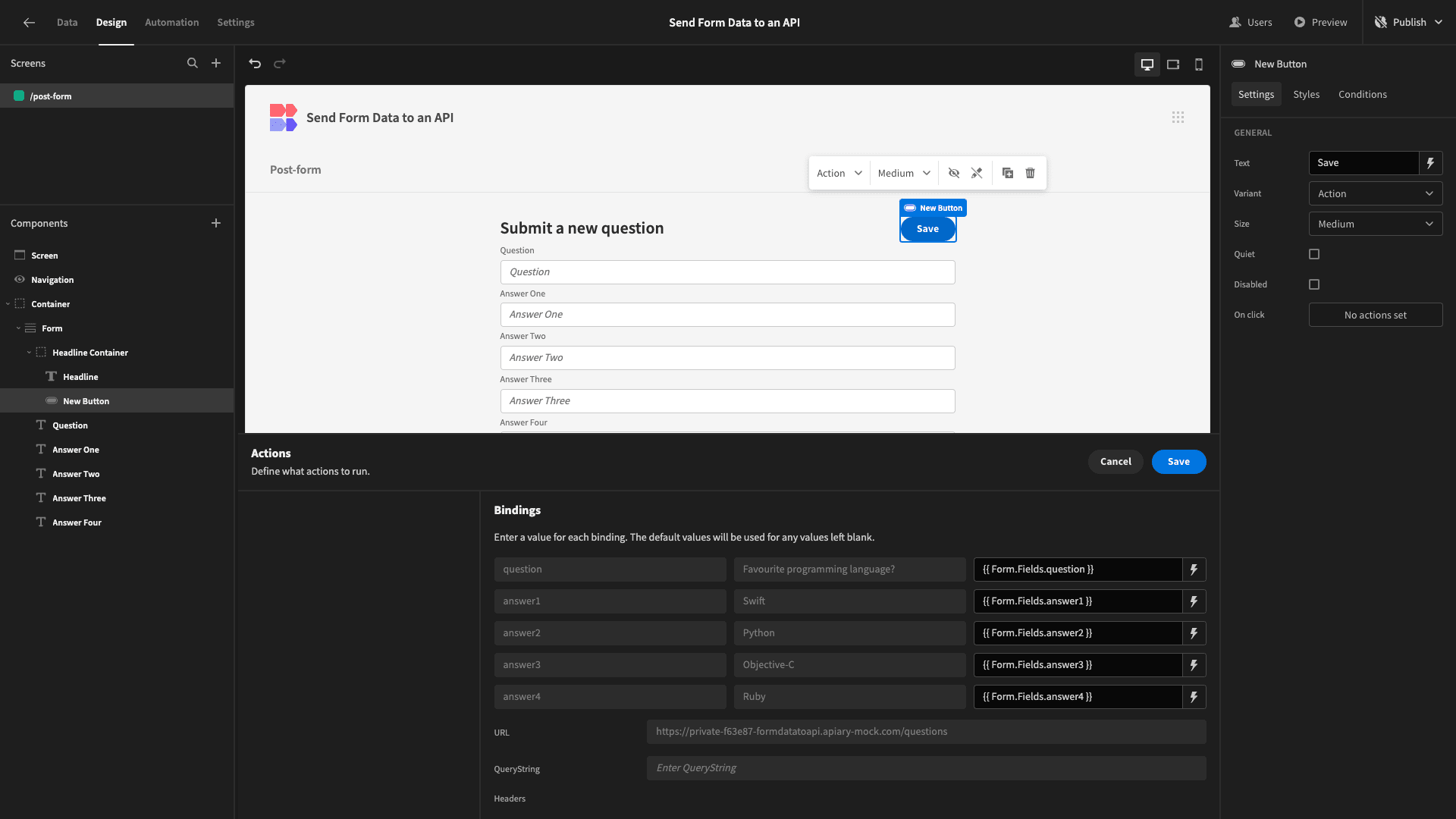
For instance, we might want to build a form to send data to an API request:
Join 300,000 teams running operations on 91制片厂
Turn data into action
91制片厂 is the ideal solution for busy IT teams that need to output professional solutions at pace. Connect your data, build interfaces, add automations, and deploy your tools however you like, with minimal manual coding.
Let鈥檚 check out what makes 91制片厂 tick.
Our open-source, low-code platform
At 91制片厂, our mission is to help teams turn data into action. We offer extensive external data support, autogenerated UIs, powerful automations, flexible self-hosting, a generous free tier, multi-player collaboration, and much, much more.
Check out our features overview to learn more.
External data support
91制片厂 is the clear market leader for data support. We offer dedicated connectors for all kinds of RDBMSs, NoSQL tools, and REST APIs.
We鈥檝e also got our own built-in database, along with full support for custom data sources.
Optional self-hosting
Deploy your 91制片厂 installation to your own infrastructure for maximum control. We offer optional self-hosting with Kubernetes, Digital Ocean, Docker, Linode, Portainer, and more.
Or, you can use 91制片厂 Cloud and get up and running in minutes, letting us take care of everything. Check out our pricing page to learn more about both options.
Automations and integrations
91制片厂 offers powerful custom automations with minimal manual coding. Combine and configure our built-in triggers and actions to craft the perfect rules to streamline your internal processes.
We also offer support for a huge array of third-party app integrations, using REST API, Zapier, WebHooks, and more.
Role-based access control
Seamlessly marry security and user experience with our built-in role-based access control. Assign users to defined roles and grant permissions based on data sources, queries, automation rules, app screens, and individual components.
We also offer secure environment variables - alongside free SSO.
Custom plug-ins
91制片厂 won鈥檛 be beaten for extensibility. Build your own custom components, data sources, and automation actions with our dedicated CLI tools. Or, import community contributions from GitHub in just a few clicks.
Check out our to learn more.