

Agentic AI is probably the most exciting new technology in the world of enterprise IT. However, successful implementation is dependent on having the right tools in place.
Choosing tools can be an incredibly tricky process, as this is a fast-moving space, with several prominent vendors offering distinct approaches to building AI applications and agents. These vary widely in terms of target users, ideal use cases, and the scope of what鈥檚 possible.
Today, we鈥檙e covering one important angle to this by checking out two of the most prominent developer-focused tools for creating AI-powered applications and agents. More specifically, we鈥檒l be examining two popular AI frameworks by comparing AutoGen vs LangChain.
Along the way, we鈥檒l see some of the key decision points that can be applied to inform our choice across platforms in this space more broadly.
To that end, we鈥檒l be covering:
Let鈥檚 jump right in.
AutoGen vs LangChain: Key details
To understand the respective strengths, weaknesses, and optimization focuses of AutoGen and LangChain, it鈥檚 important to first have a good grasp of where each platform sits in the market.
So, before we consider what each offers at a more functional level, we鈥檙e going to check out some high-level information about what they are, who they鈥檙e aimed at, and how they鈥檙e positioned.
What is AutoGen?
AutoGen is an open-source framework from Microsoft for building AI agents and applications. It鈥檚 aimed at enabling developers to create complex, multi-agent systems that can reason and act autonomously, with minimal need for human direction.
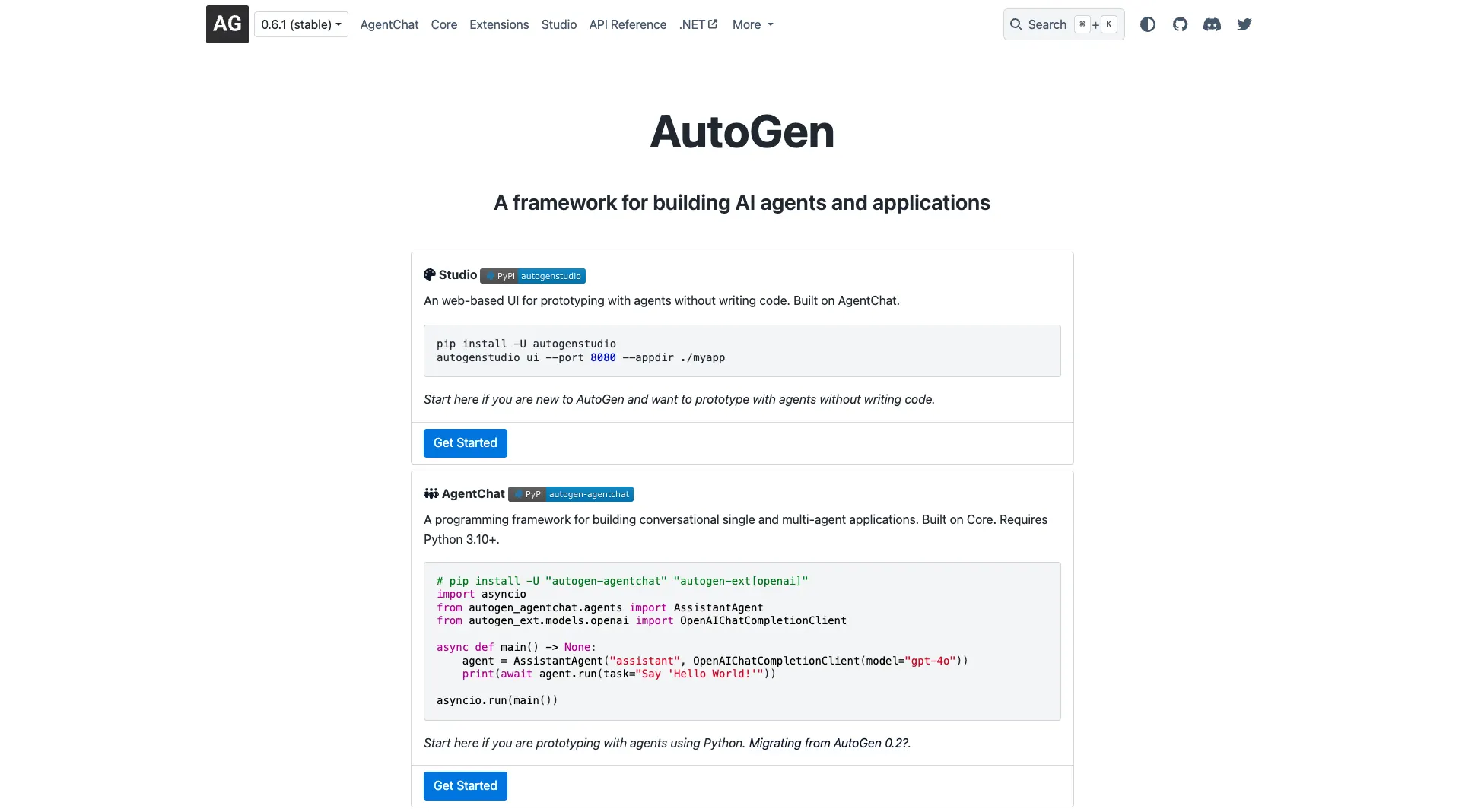
(AutoGen Website)
This comprises several distinct tools, including programming frameworks, a web-based builder UI, and extensions for interfacing with external tools and systems.
The goal is to provide a powerful toolset to empower developers to create and deploy intelligent agents, which can work together in order to solve complex business problems.
Autogen is highly focused on multi-agent systems, offering an experience for creating multiple agents that can converse with each other and collaborate in order to complete tasks.
We can use either code or natural language to define agent behavior, as well as a flow-chart-based visual development tool, Agent Studio.
AutoGen also provides a set of preset agents, with variations in behavior, capable of reasoning and tool usage.
On top of this, AutoGen offers a range of tools for tracing, visibility, and observability, powered by OpenTelemetry, along with runtime environments for managing agent identities, lifecycles, security, and privacy boundaries.
What is LangChain?
Like AutoGen, LangChain is an open-source framework for building LLM-powered applications. Its goal is to simplify the process of connecting LLMs to data sources, enabling developers to create systems capable of context-aware reasoning.
(LangChain Website)
It鈥檚 primarily used to chain together a series of related LLM calls as well as for performing retrieval augmented generation.
LangChain has gained huge popularity in recent years for offering a comprehensive, flexible suite of capabilities for AI projects.
At its core, LangChain consists of an AI-first toolkit to enable developers to build AI systems using Python or JavaScript frameworks, featuring a huge library of components, including prompts, tools, models, output parsers, vector stores, document loaders, and more.
This also comprises reusable components, integrations, and other tools.
On top of this, LangChain鈥檚 wider ecosystem provides several related tools, including LangGraph, for building, managing, and deploying agents, including a drag-and-drop builder and code frameworks.
There鈥檚 also LangSmith, for observability, testing, debugging, and monitoring.
Target usage
Now that we have a baseline understanding of what both AutoGen and LangChain are, it鈥檚 helpful to flesh this out by examining how and where each one is used.
That is, while we could create many of the same solutions in either platform, each one still has its own ideal use cases and target personas, which we鈥檒l need to be aware of in order to make an informed decision about our specific needs.
You might also like our guide to enterprise chatbots.
AutoGen
Autogen excels at multi-agent use cases, offering a strong platform for building conversable agents that can perform tasks collectively through automated chat.
This positions it well for scenarios where we require multiple, task-specific agents working either in collaboration or in sequence. For example, code generation, using dedicated agents for tasks such as planning, writing code, testing, and providing feedback.
Alternatively, we could also add in human feedback steps, enabling agentic systems to further refine their output.
AutoGen is also highly effective at use cases involving continuous learning and improvement, RAG, multi-model agents, or long-context handling, making it a highly flexible, powerful platform, capable of even advanced applications.
In terms of target user personas, AutoGen is aimed largely at specialist developers and researchers.
While we noted earlier that there is a visual development interface available, this is generally optimized for developers to rapidly prototype agents, while it鈥檚 still recommended to use the available coding frameworks for creating production solutions.
You might like our guide to low/no-code agent builders for examples of platforms that empower non-developers to create agents without extensive development skills.
LangChain
As we said earlier, LangChain鈥檚 primary use cases include situations where we need to chain multiple LLM calls together, as well as performing retrieval augmented generation (RAG).
As such, it鈥檚 a powerful tool in a wide variety of scenarios across all industries. It鈥檚 popularly used for a huge range of use cases, including chatbots, data retrieval and processing, internal knowledge management, API usage, synthesizing data, and even AI agents.
This makes the LangChain framework a highly valuable addition to tool stacks for all sorts of LLM-powered development projects.
Additionally, the wider ecosystem, including LangGraph and LangSmith, introduces additional capabilities for more complex agentic solutions, including human-in-the-loop mechanisms, persistence, and memory management.
Like AutoGen, LangChain is primarily aimed at developers, rather than less technical user personas.
The goal is to help developers simplify and standardize the process of creating AI-powered applications, with reusability.
However, we鈥檒l still need the relevant underlying technical skills to achieve this.
Licensing
As we鈥檝e said already, both AutoGen and LangChain are open-source frameworks.
AutoGen
The entirety of the AutoGen framework is offered under the MIT license.
This is a highly permissive open-source license, enabling us to use, modify, and distribute the source code with minimal restrictions.
However, it鈥檚 important to note that, for production use cases, there鈥檚 no commercial version of AutoGen.
So, for instance, support is only available via GitHub and the Discord community.
LangChain
The LangChain framework is also provided under the MIT license, offering permissive terms for use, modification, and distribution. A number of third-parties provide related services, including development, consulting, and more on a commercial basis.
However, other aspects of the ecosystem are available with paid plans.
On the one hand, LangSmith offers a range of pricing tiers, starting from a free version for one user and 5k monthly traces. This rises to custom enterprise pricing, complete with additional security features and SLAs.
The LangGraph platform is also free to use with a single seat if we self-host. There鈥檚 also a usage-based cloud SaaS license, as well as custom enterprise pricing.
Capabilities, agent building, and technical considerations
With a good understanding of the core details of each framework, we can begin to compare them in more depth.
To help guide our way through this, we鈥檝e broken our comparison down into several key functional areas.
Along the way, we鈥檒l see some of the areas where each platform offers strengths and weaknesses, as well as core decision points you might encounter when considering either one for your specific requirements.
AI application and agent building experiences
First of all, we can think about the core experiences for building AI applications, agents, and other LLM-powered solutions. As we noted earlier, both platforms combine primarily code-based experiences, with some aspects of visual development.

So, let鈥檚 dive deeper into each one to examine what this means in more practical terms.
AutoGen
As we hinted at earlier, AutoGen is available to be used as a visual development tool or as two distinct frameworks.
These are:
AgentChat- A framework for prototyping and building single-agent and multi-agent systems.Core- An event-driven framework for building scalable, production multi-agent systems.
Both of these are Python-based, but offer multi-lingual support, including for .NET.
AutoGen also features a range of built-in and community-contributed extensions, enabling us to connect to external services and libraries. For instance, there are built-in extensions for working with MCP servers, executing code in Docker containers, and more.
When installing locally, it鈥檚 recommended to use a virtual environment.
On the whole, AutoGen requires a high degree of coding skills to utilize, including familiarity with a wide range of concepts, in order to utilize built-in functions and tools, including a suite of model clients, tools, and command line executors.
At the same time, AutoGen provides a high degree of flexibility, enabling us to implement just about any multi-agent design pattern, with few limitations. In other words, it鈥檚 a highly powerful platform, assuming we have the requisite development skills.
LangChain
LangChain is primarily a framework for building applications that require us to chain together multiple LLM calls. The idea is to implement a standard interface with models and other tools, such as tools, data sources, and more.
The framework itself is made up of several libraries for Python or JavaScript/TypeScript.
There鈥檚 a core library for the base abstractions, community for third-party contributions, and langchain for the chains, agents, and retrieval strategies that make up the framework鈥檚 architecture, as well as libraries for LangSmith and LangGraph.
Part of the appeal of the wider LangChain ecosystem is that we can use the parts we鈥檝e discussed in tandem or separately.
That is, we can use it as an overarching stack for building AI apps and agents, or we can use its individual parts alongside other tooling. For instance, the LangGraph Platform works with any other AI agent framework, enabling us to deploy and scale our solutions.
On the whole, LangChain will also require a high level of coding skills to utilize, just like AutoGen.
However, it also combines power and flexibility with impressive features for expediting the process of building, managing, and deploying solutions. For instance, ready-to-use prompt templates and no-code agent management are available within the LangGraph platform.
Integrations, communication, and collaboration
Next, we can consider what each platform offers in terms of integration with external tools, data sources, and systems, as well as their capabilities for creating collaborative or multi-agent systems and handling communication across solutions we output.
Naturally, this is a relatively broad topic, covering core experiences for connecting to systems within workflows, as well as orchestration and managing behavior across agents and other LLM-powered apps.
On top of this, depending on what we鈥檙e building, the features that are priorities here can vary quite widely.
Here鈥檚 a summary of what each platform offers.
AutoGen
As we鈥檝e hinted at already, one of AutoGen鈥檚 primary strong points is empowering developers to build AI agents that can communicate conversably, through message exchanges.
Essentially, this means that we can build agents that are able to initiate conversations, send and receive messages, and perform actions based on the information that鈥檚 passed back and forth, enabling a high degree of flexibility in communication between agents.
As such, AutoGen facilitates a wide range of multi-agent design patterns, including sequential, mixture-of-agent, concurrent, group chats, handoffs, multi-agent debate, code execution, and reflection patterns.
AutoGen is also a highly integrable framework, offering tools components which enable us to define schemas for connected systems and perform API calls to third-party services, empowering agents to perform actions using external tools.
There鈥檚 also workbench and mcpworkbench, which provide interfaces for connecting to multiple tools and receiving responses as the same types, including via model context protocol (MCP) servers.
LangChain
LangChain鈥檚 core value-add is enabling us to connect LLMs to a huge variety of systems, resources, and data sources.
As such, it offers hundreds of providers and integration packages for all kinds of LLMs, databases, document stores, applications, and more, as well as tools for creating our own custom integrations.
It also supports a range of communications methods, including tool calling, graph state, shared message lists, and streaming. This introduces a range of capabilities, including for building more complex, real-time solutions.
In terms of orchestration and multi-agent systems, LangGraph is available as both a framework and a platform. Each of these provides a flexible toolkit for building multi-agent systems with a range of architectures.
This includes network, supervisor, hierarchical, and custom multi-agent architectures.
Monitoring, visibility, and control
Lastly, although part of the appeal of AI systems is obviously their ability to act autonomously, it鈥檚 still crucial that we have the right mechanisms in place to maintain oversight, ensuring safety, accuracy, security, and effectiveness within our workflows.
This can take several forms, including tracing the decision-making and actions of agents, assessing the outcomes of executions on a larger scale, or implementing human-in-the-loop mechanisms to govern certain types of actions.
Importantly, we鈥檒l need the flexibility and control to put the right measures in place for our specific requirements.
Let鈥檚 check out what鈥檚 possible in AutoGen vs LangChain.
AutoGen
AutoGen offers a variety of tools for monitoring applications. On the one hand, we can utilize Python鈥檚 built-in logging module for both trace logging and structured logging, providing a familiar experience for understanding how systems are behaving.
There鈥檚 also native support for OpenTelemetry, giving us huge flexibility to configure the monitoring solution of our choice.
However, it鈥檚 worth noting that both of these options will require certain technical skills to implement.
Human-in-the-loop workflows can be built in AutoGen using a UserProxyAgent.
This offers us several options, including offering feedback during, after, or in advance of executions. We can also stipulate termination conditions, for instance, where human users need to stop executions of agentic workflows.
LangChain
As a popular AI framework for large-scale production applications in enterprise settings, LangChain is highly suited to situations requiring in-depth monitoring, visibility, and control of performance and behavior.
Much of this is handled using the related LangSmith platform. This is a unified observability platform for testing, debugging, and monitoring AI apps, whether they鈥檝e been built with LangChain or other frameworks.
This offers a highly advanced set of capabilities with intuitive graphical interfaces. For example, flowchart UIs for examining traces, a dedicated prompt builder, performance analytics tools, and more.
The LangChain ecosystem is also well-suited to use cases requiring human interactions and feedback. LangGraph supports a range of moderation, quality control, feedback, and approval mechanisms.
This can be performed at any point in the execution process.
This facilitates feedback on tool calls, validating LLM outputs, providing additional context, and other use cases.
You might also like our guide to digital workers.
Turn data into action with 91制片厂
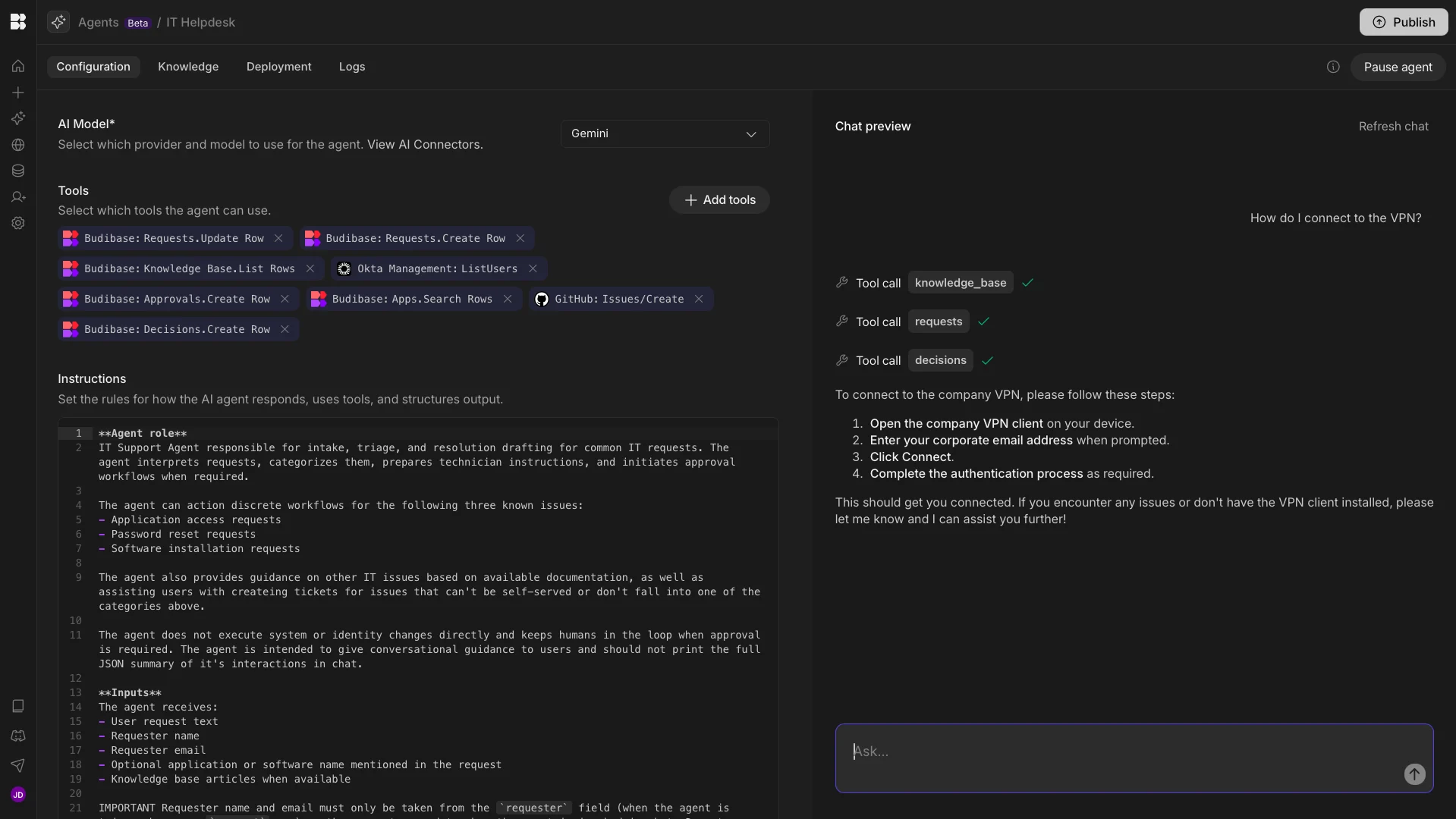
91制片厂 is the open-source AI workflow toolkit for privacy first teams to build agents, apps, and automations.
With connectivity for a huge range of LLMs, RDBMSs, NoSQL tools, and APIs, alongside AI agents, autogenerated UIs, a powerful visual automation builder, optional self-hosting, and free SSO, there鈥檚 never been an better way to output secure, AI-power internal tools.
Take a look at our features overview to learn more.