

AI is forming a key part of more and more development projects. While this obviously offers massive benefits, it also introduces some important challenges, including securing the required skills and resources to create internal solutions.
Today, we鈥檙e diving deep into how to build LLM-powered applications, including practical examples of how 91制片厂 empowers you to utilize AI within our low-code platform.
Specifically, we鈥檒l be covering:
- What is an LLM-powered application?
- Key use cases and examples
- Benefits and challenges
- AI capabilities in 91制片厂
Let鈥檚 start with the basics.
What is an LLM-powered application?
An LLM-powered application could be any software tool that incorporates AI. This could be for a single function or in a more wholesale fashion.
So, for instance, we could utilize AI to implement specific functionality within an existing application, or some use cases may be more deeply AI-focused, such as chatbots.
In any case, the goal is to leverage the capabilities of AI within day-to-day processes and workflows.
Generally speaking, applications rely on calls out to external models, whether these are provided as a cloud service or accessed locally.
As such, developers don鈥檛 typically need to create entirely new AI capabilities from scratch. Rather, the more important skill is often knowing how to work with existing AI services, including how they interact with various parts of our application.
Types of AI applications
As you might imagine, AI-powered applications can vary widely, both in terms of the specific functions they鈥檙e designed to carry out, and the architecture and technology they rely on to achieve this.
At the same time, it鈥檚 helpful to examine a few key categories of tools that we鈥檙e most likely to encounter.
As we said earlier, many tools leverage AI for individual, discrete functions within an existing workflow. For example, any application that relies on an LLM-based function instead of scripted logic.
We can essentially think of this as using AI to perform defined functions within otherwise deterministic workflows.
Of course, a huge proportion of AI applications also surround natural language processing.
Even within this, we can see a large amount of variety in terms of the complexity of solutions. So, at one end of the spectrum, we could have tools that perform relatively discrete natural language tasks, like extracting variables for inputs or translating text.
However, this also includes more sophisticated NLP-based applications, including chatbots, code generation tools, or virtual assistants.
Nowadays, more and more attention is being paid to the idea of AI agents. These are LLM-powered systems that are capable of autonomous reasoning and actions, making them suited to non-deterministic workflows.
As well as this, many LLM-powered applications revolve around monitoring and anaylzing data, often independently of human interactions.
For instance, real-time systems that are able to detect anomalies or perform predictive analytics.
Take a look at our guide to AI agentic workflows to learn more.
Key use cases and examples
With a clear understanding of the high-level ways that LLM-powered applications might function, we can drill deeper into some of the most common use cases, especially in the context of internal tools and workflows.
A crucial cluster of use cases here surrounds internal services, such as HR and ITSM. For example, AI-powered self-service portals, service desks, enterprise chatbots, or agentic systems can be used to replicate human decisions and actions within these workflows.
This can work in a few different ways. As above, we might implement specific AI functions within deterministic workflows, or we could implement agents that fully replicate certain roles within our service portfolio, like front-line support.
Of course, we鈥檒l also often see similar types of applications within customer-facing workflows, including for service and after-sales.
Beyond this, AI applications can be utilized in a wide range of deterministic and non-deterministic administrative and back-office processes, with key use cases including:
- Data extractions,
- Document processing,
- Translation,
- Categorizations,
- Response generation,
- Automating approvals,
- Intelligent routing,
- Triaging issues and requests,
- Monitoring and predictive analytics,
- Dynamic workflow automations.
For a more in-depth look at how some of these might look in practice, take a look at our guide to AI for ITSM.
Benefits and challenges
Knowing what LLM-powered applications can help us achieve in terms of specific functions and use cases, it鈥檚 also important to consider the business-level implications, as well as some of the associated costs and limitations.
In other words, what are the pros and cons of adopting AI within workflow tools, especially compared to alternative approaches, such as strictly deterministic, scripted logic or even human-led workflows?
Some of the key benefits of LLM-powered applications include:
- Expanding automation use cases - enabling us to handle tasks and functions that would be difficult or even impossible with traditional automation tools.
- Reducing the need to hard-code logic - implementing logic with natural language prompts, rather than requiring extensive coding skills to implement it using scripting.
- Efficiency gains - enabling us to manage workflows more cost-effectively, including reducing the need for human interactions.
- Enhanced user experiences - especially providing more natural interactions for end users.
- Improved decision-making - providing insights and tools that can assist us with decision-making.
- Expediting resolutions - enabling faster resolutions to common queries than strictly human-led workflows.
- Scalability and maintainability - workflows can be easily modified by altering prompts, rather than having to manually alter code or scripts.
- Continuous improvement - some AI-powered applications can remember previous executions, using memory to inform future actions, thus providing continuous improvement.
- Handling natural language, unstructured, and qualitative data - for instance, enabling end users to describe issues in their own words, rather than submitting strictly formatted data.
At the same time, it鈥檚 important to be realistic that AI functions aren鈥檛 the appropriate option in all cases. Indeed, there are a number of challenges and limitations we鈥檒l need to be aware of that might make scripted logic or more human-centric workflows more suitable in certain cases.
In particular, this includes:
- Resource intensity - AI-powered tools may require comparatively high computational resources.
- Ongoing costs - if we鈥檙e reliant on external services to provide AI capabilities, the costs of this will need to be factored in.
- Visibility, observability, and auditing - without the right measures in place, it can be difficult to understand what LLM-powered systems are doing and why.
- Reliability - due to the nature of AI-powered logic, it鈥檚 possible that the same results won鈥檛 be arrived at for similar inputs across executions.
- Security considerations - including how we expose AI models to data, tools, or other resources.
- Technical requirements - LLM-powered systems present unique technical challenges, especially around integrations and access control.
- Skills barriers - we may require specialized technical skills and knowledge to implement systems.
- Resistance to change - we might face resistance to change from a range of stakeholders, including on-the-ground colleagues, end users, and top-level decision makers.
- Tool selection and return on investment - with AI being a fast-developing technology, many businesses are struggling to select the right platforms and ultimately achieve ROI.
AI capabilities in 91制片厂
91制片厂 is the open-source, low-code platform that empowers IT teams to turn data into action.
Alongside extensive support for all kinds of data, autogenerated UIs, powerful visual automations, custom RBAC, and more, 91制片厂 offers a whole suite of AI-driven capabilities, making it the perfect solution for outputting modern, secure internal tools.
To put some of what we鈥檝e learned so far into practice, we鈥檙e going to check out some of the key ways that we can implement AI functions and tools when building workflows in 91制片厂.
This includes a range of features powered by 91制片厂 AI, OpenAI, or Azure.
AI across the builder
Firstly, 91制片厂 users can take advantage of AI features across the platform to enhance developer experiences and speed up key tasks.
One huge part of this is autogenerating database schemas based on natural language prompts. For example, when creating a new app project, we can specify that we need a table for managing IT asset management requests.
91制片厂 will then output an appropriate database schema, complete with rows of dummy data.
As well as this, 91制片厂 offers AI-powered code generation within JavaScript bindings across the builder.
This opens up a range of capabilities for advanced data transformations for users with less extensive coding skills, as well as providing a helpful time-saver for those that do.
Here鈥檚 an example of how this might work, returning a date variable for next Monday at 9am.
AI columns
AI Columns within 91制片厂DB are a convenient, powerful way to carry out a range of LLM-powered tasks.
We can add AI Columns to any internal database table, utilizing a range of pre-configured prompts for common language-processing tasks like sentiment analysis, translation, categorization, summarization, and more.
We can also write custom prompts to carry out more use-case-specific actions on our data.
Let鈥檚 take an example. Below, you can see a table representing our IT tickets.
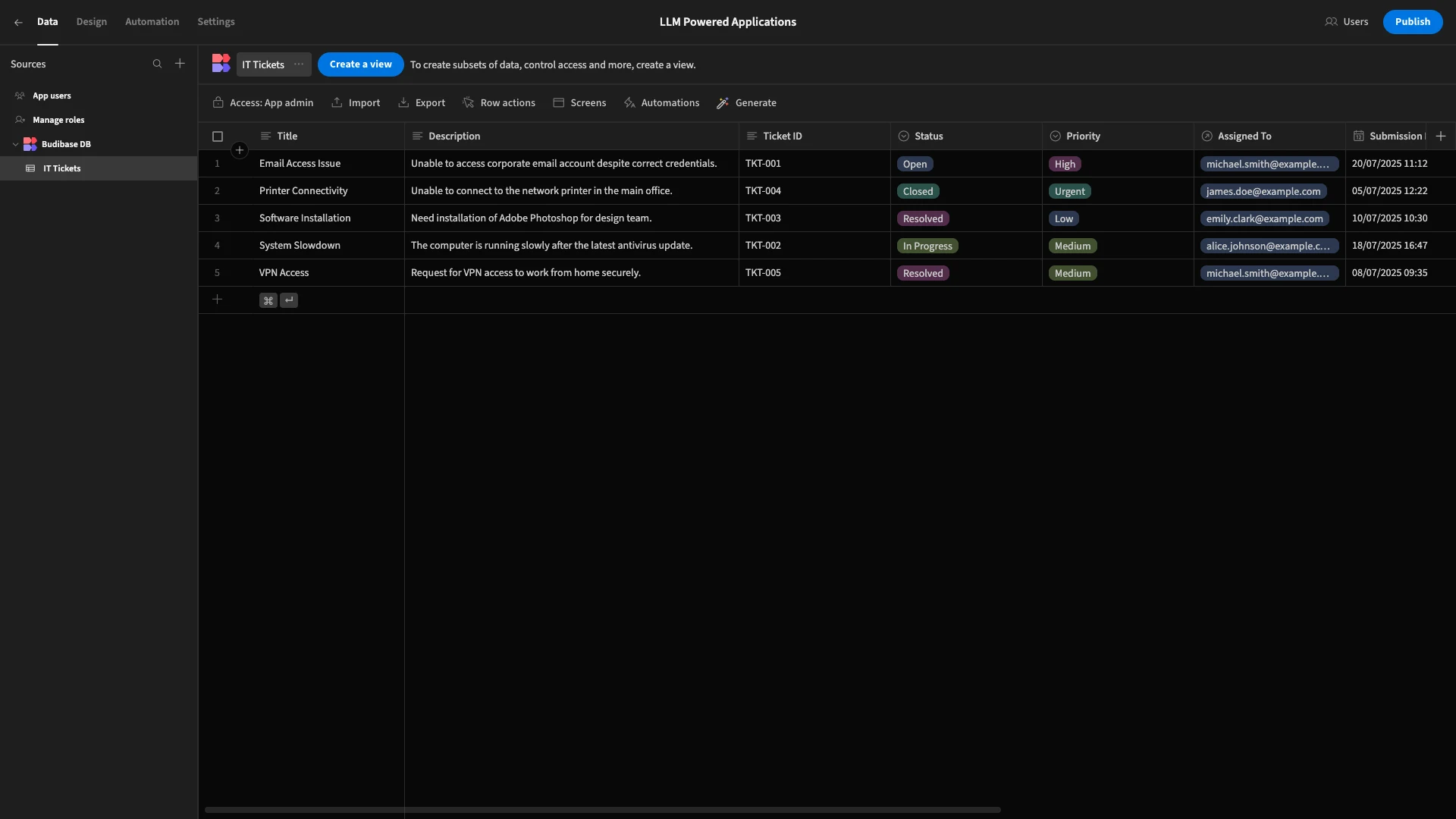
We鈥檙e going to add an AI Column to this, calling it Category and choosing Categorise Text as our Operation.
We can also choose which columns we鈥檇 like our LLM to analyze to categorize our rows. We鈥檙e choosing Title and Description.
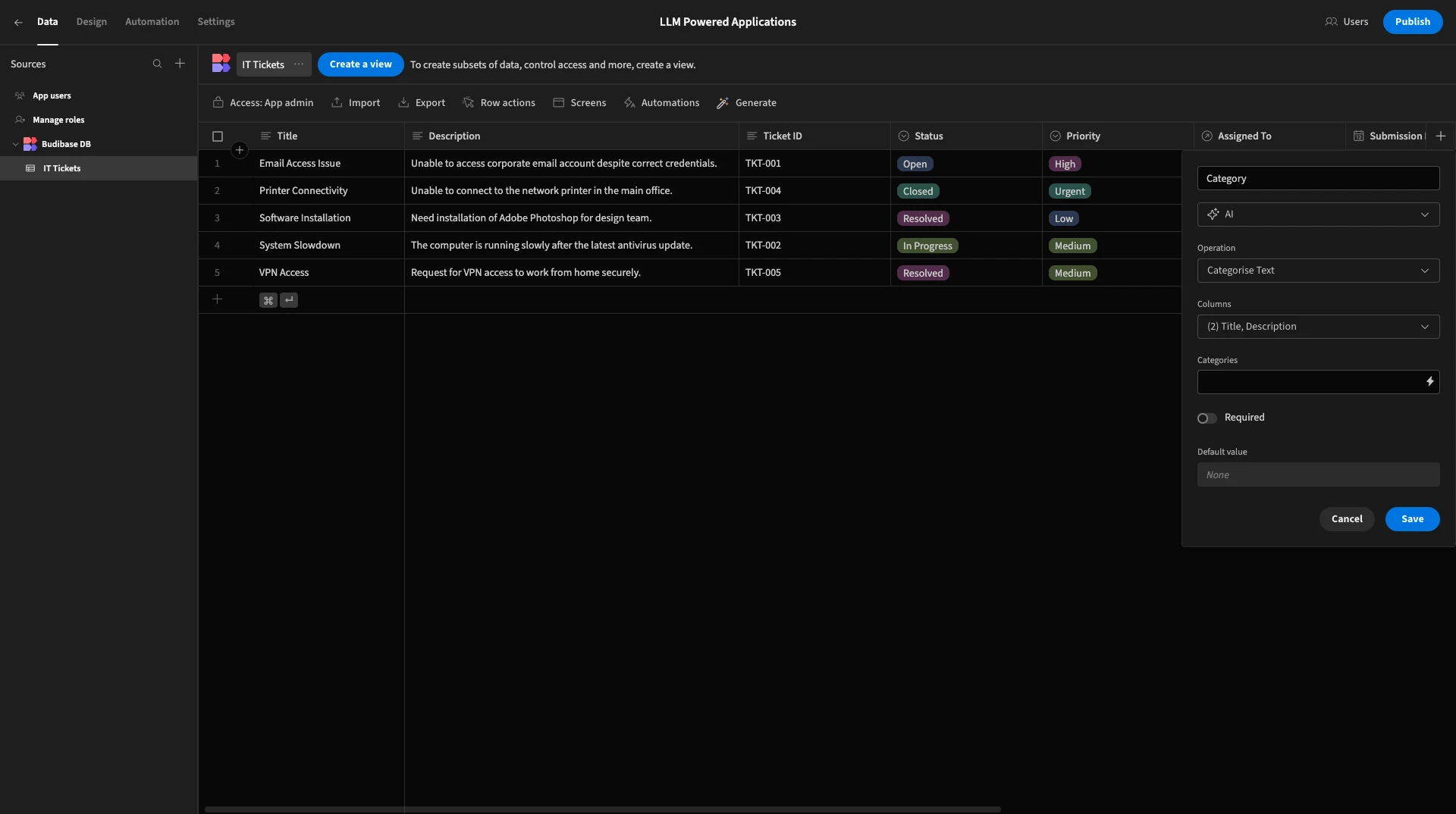
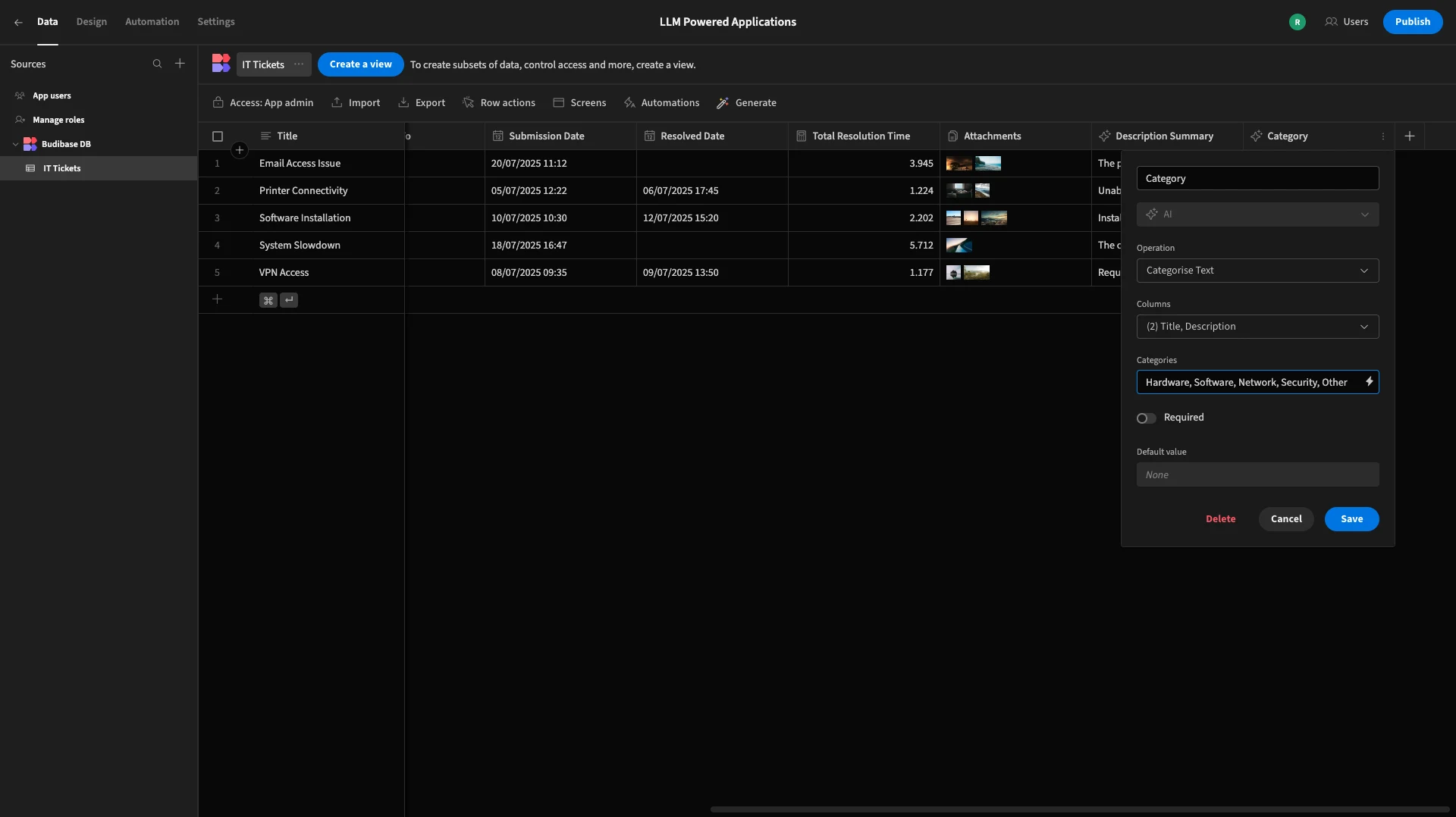
Then, we simply need to input our possible categories. We鈥檙e going with Hardware, Software, Network, Security, and Other.
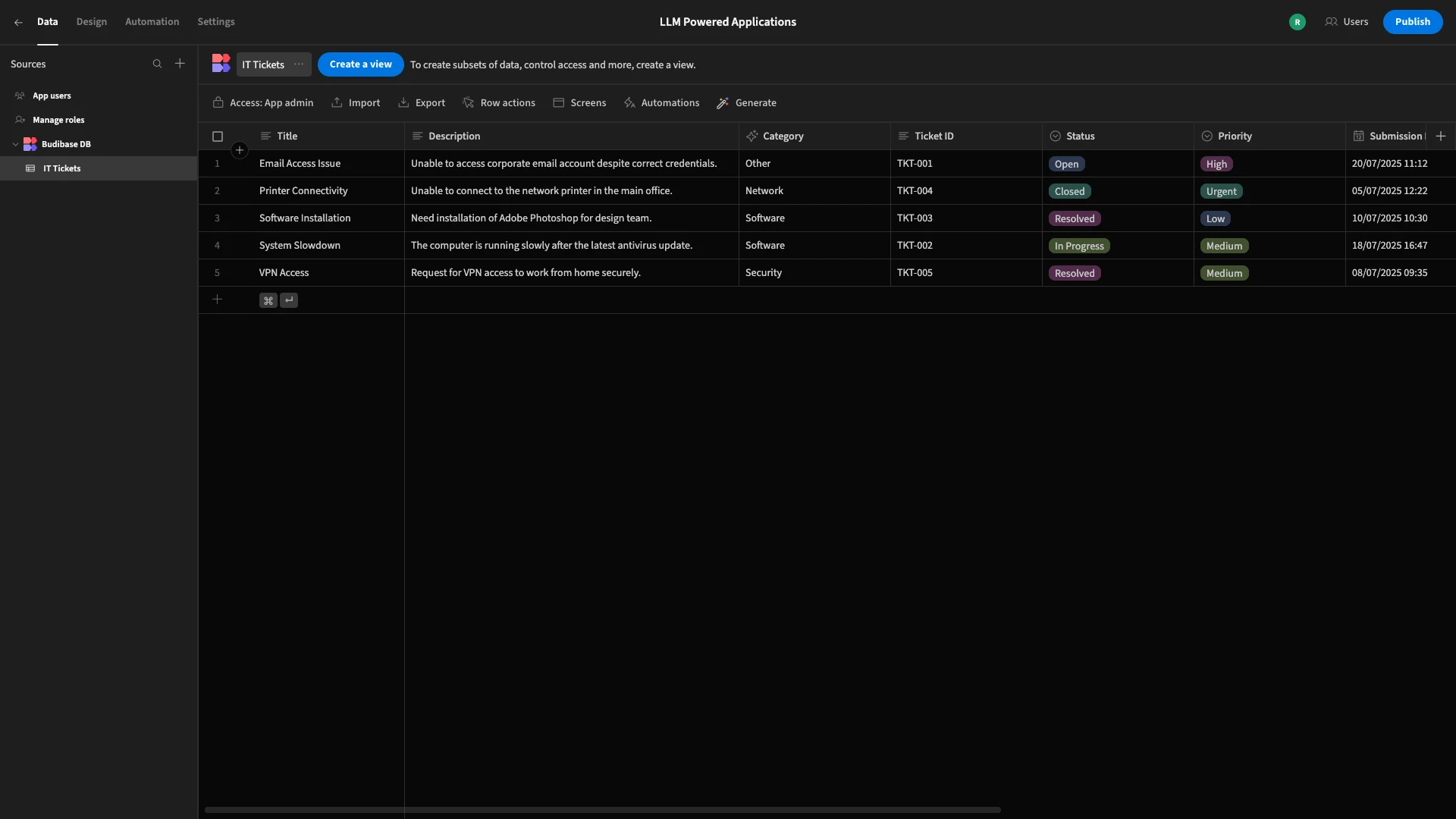
Now, when a user submits a new ticket, our AI column will automatically categorize the text.
Similarly, we can add a second AI Column, which we鈥檒l call Translation, choosing Translate as our Operation.
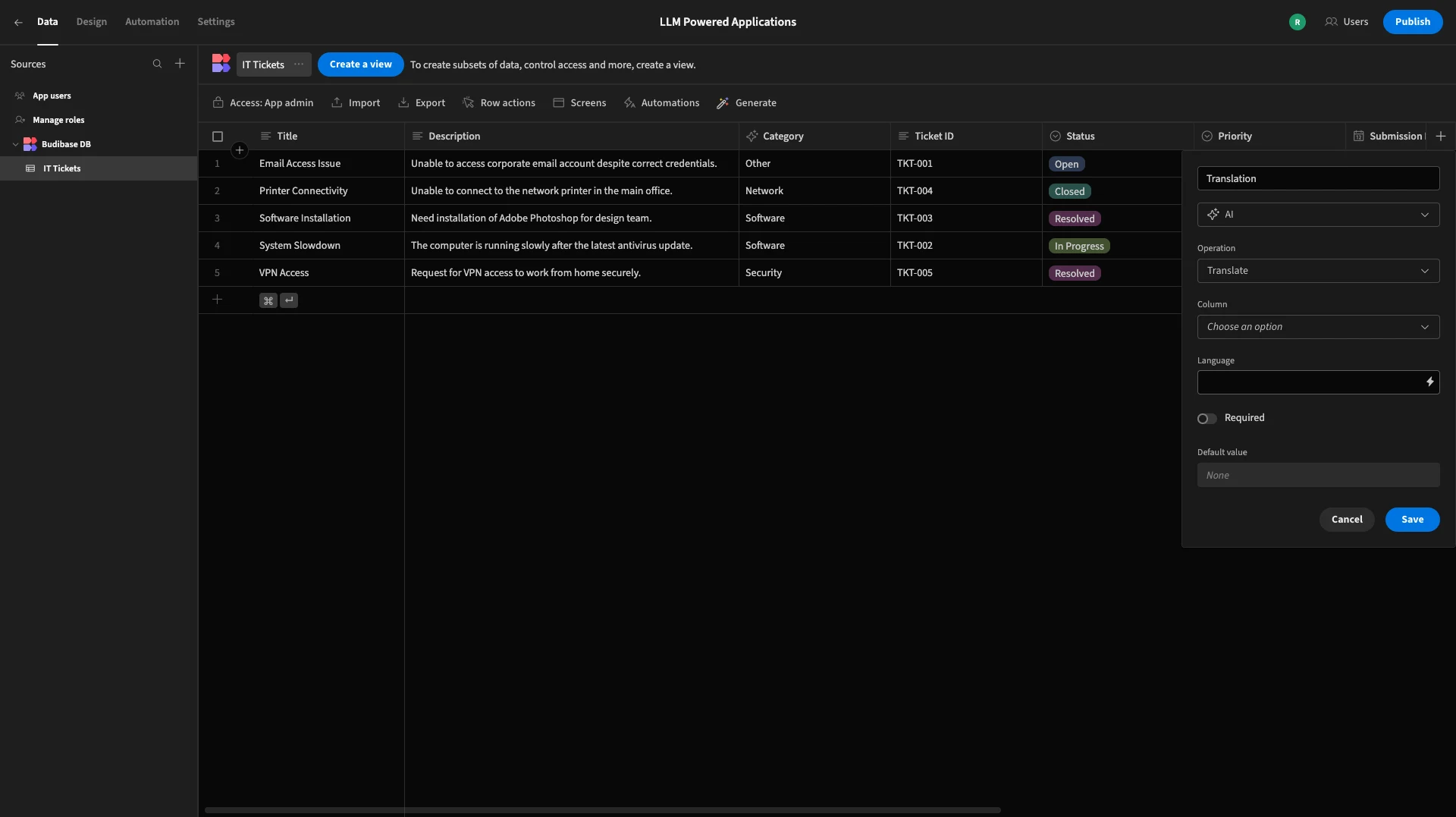
We鈥檒l then input English as our language, and choose Description under Column.
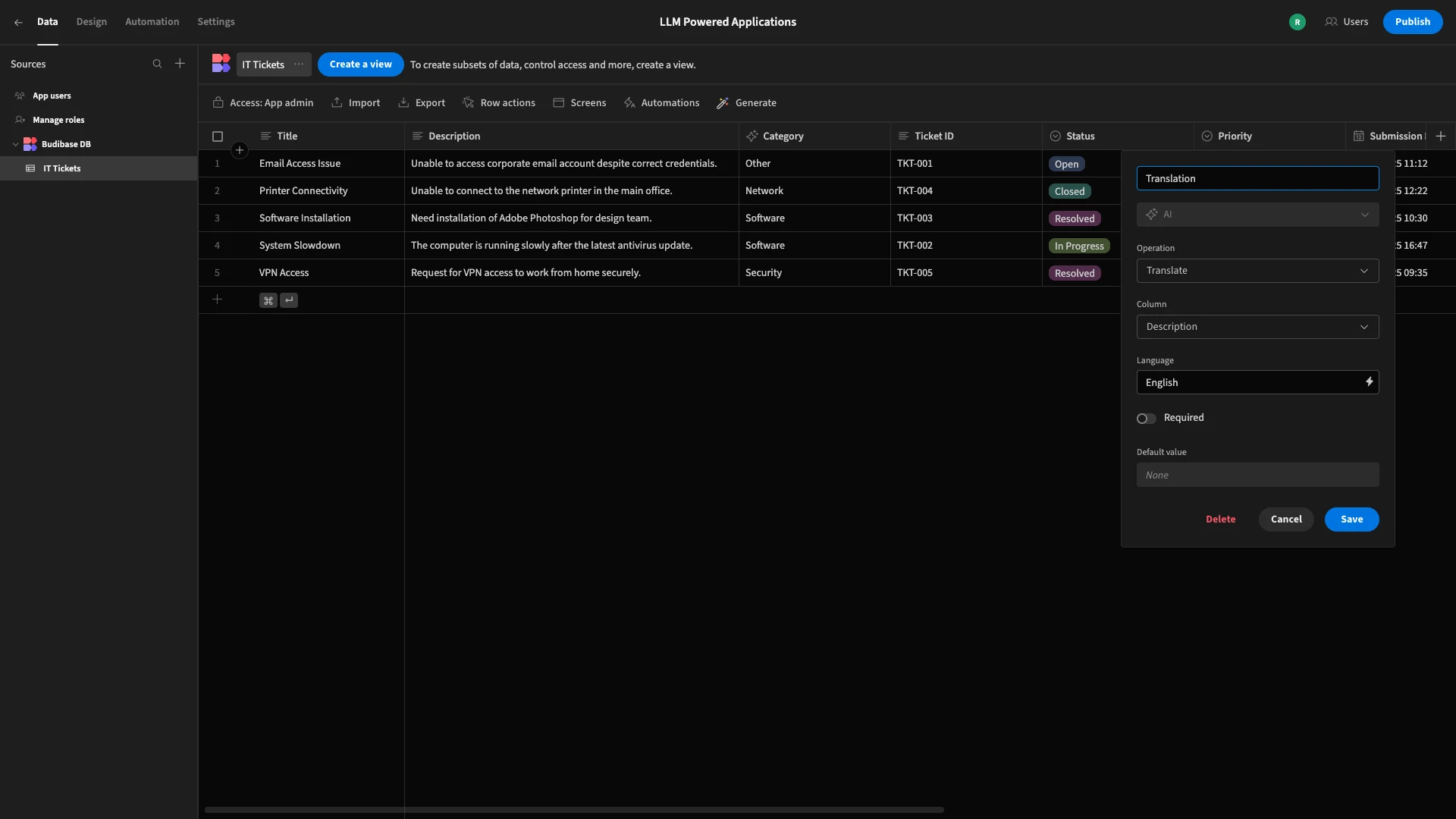
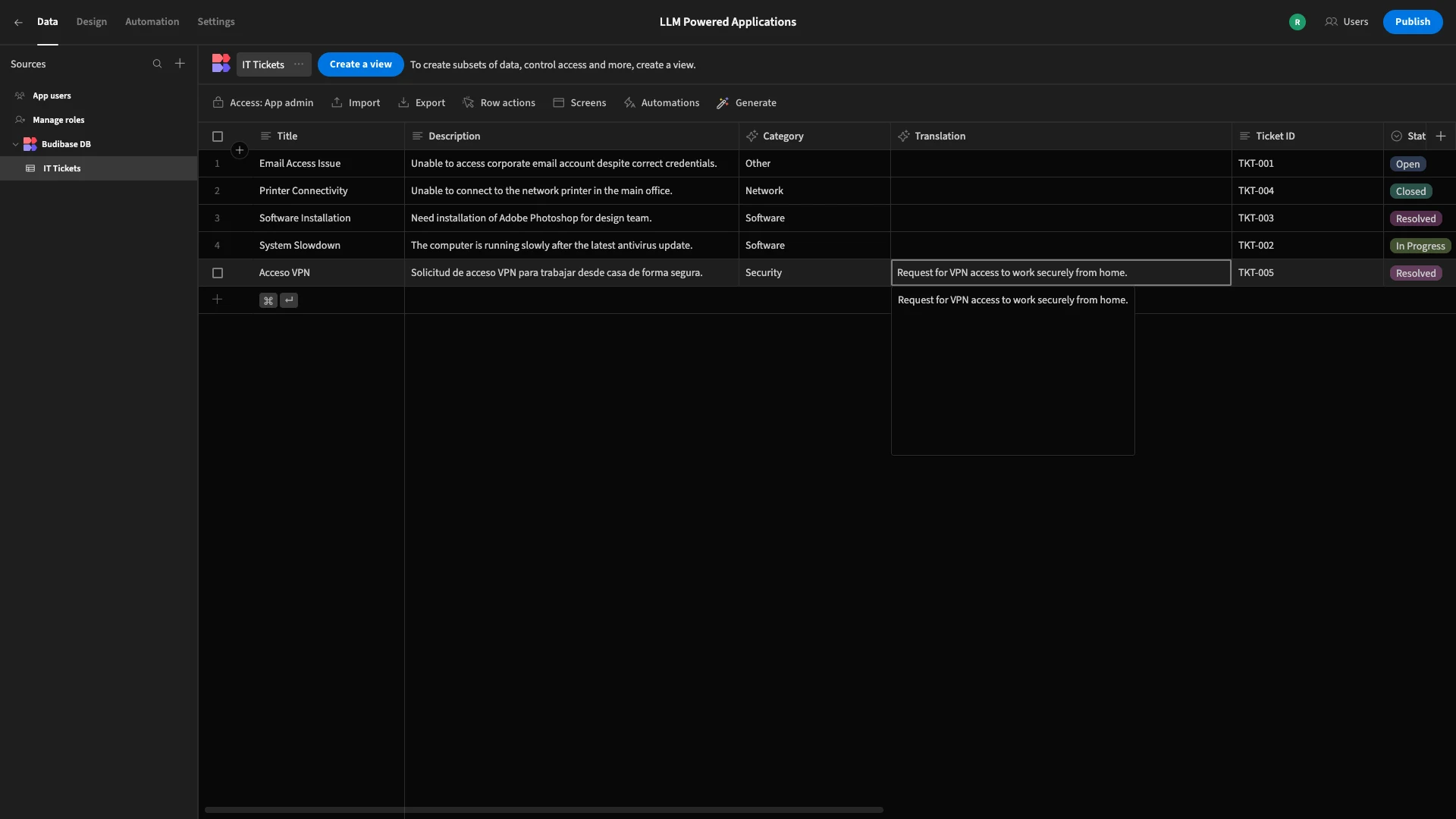
Now, we can test this out by adding a row in another language. When we do this, we can see that our Description field has been automatically translated into English.
You might also like our ultimate guide to AI forms.
AI in 91制片厂 automations
Lastly, we can also access extensive AI capabilities within 91制片厂鈥檚 Automation section, making it the perfect solution for implementing intelligent capabilities within all kinds of workflows and business rules.
Specifically, we offer dedicated automation actions for a range of functions, including translation, categorization, generating text, custom prompts, and extracting data from documents.
For our example, we鈥檒l continue using our Tickets table.
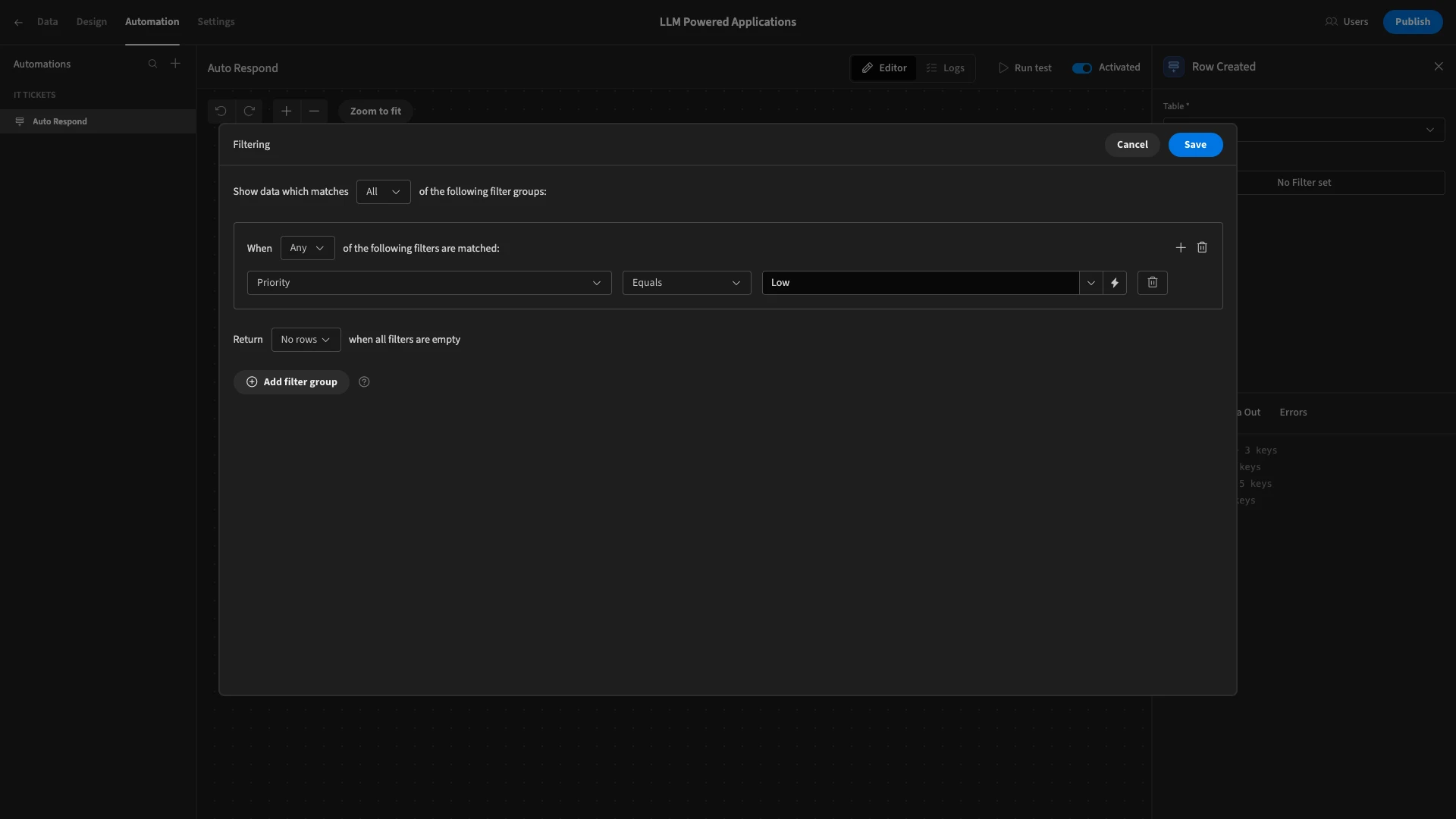
This time, we want to create an automation rule that automatically generates and sends a response for tickets with a low priority. To start, we鈥檝e chosen a Row Created trigger, which is pointed at our Invoices table.
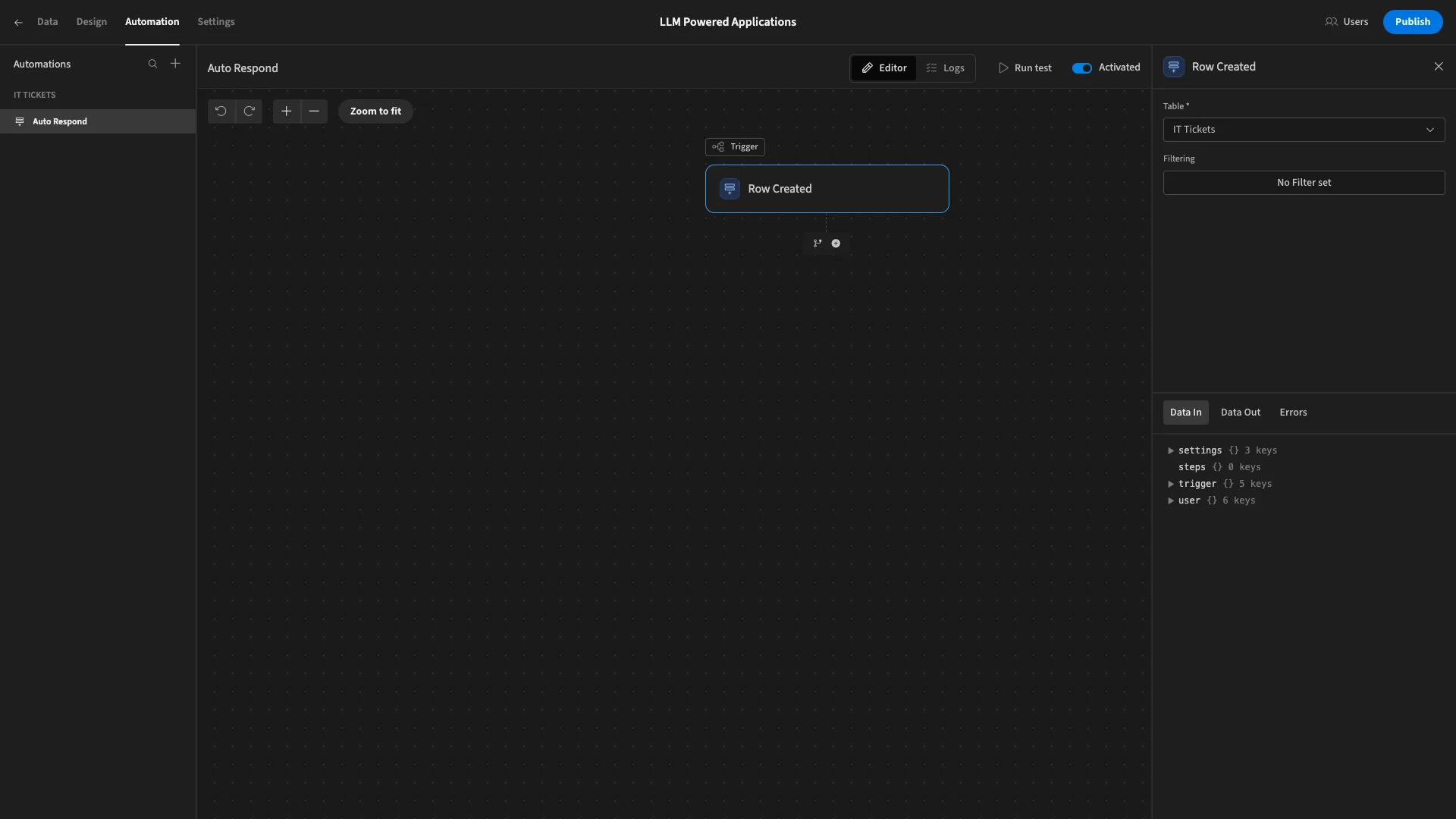
We鈥檙e also going to add a filter to this, so that our rule only continues if the Priority column is equal to Low.
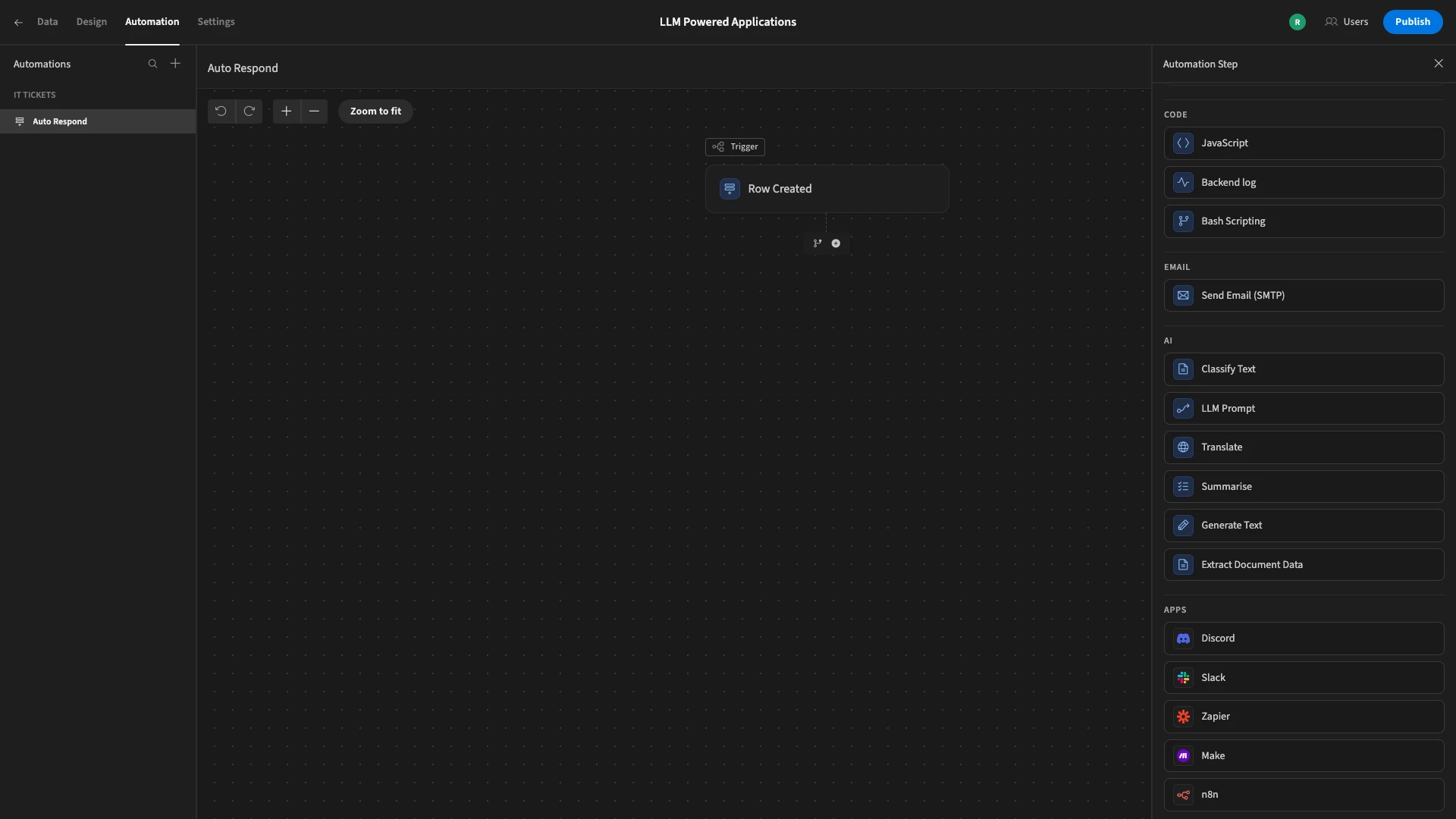
When we hit the + icon to add an action, we can see a range of options under the AI subheading.
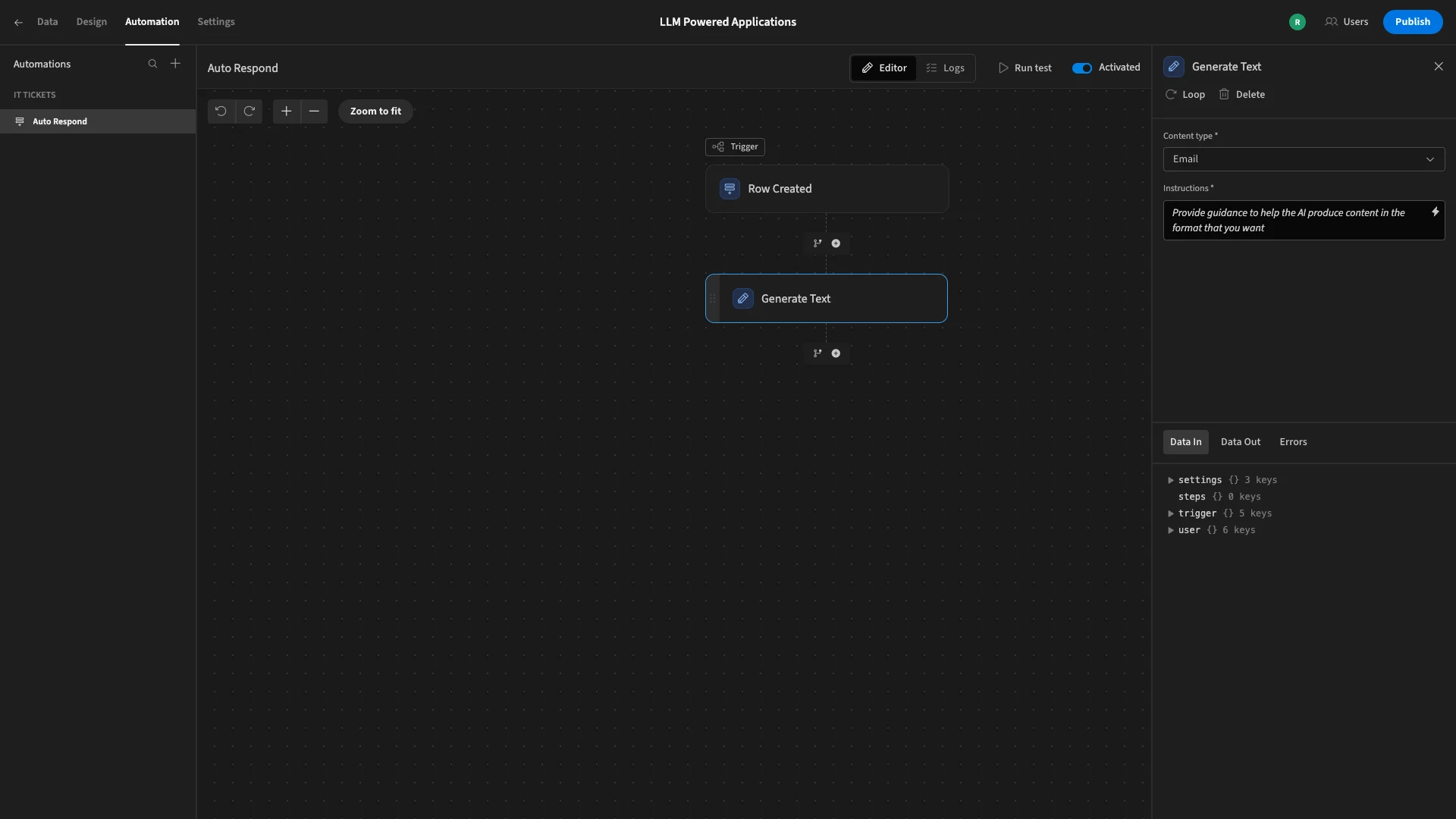
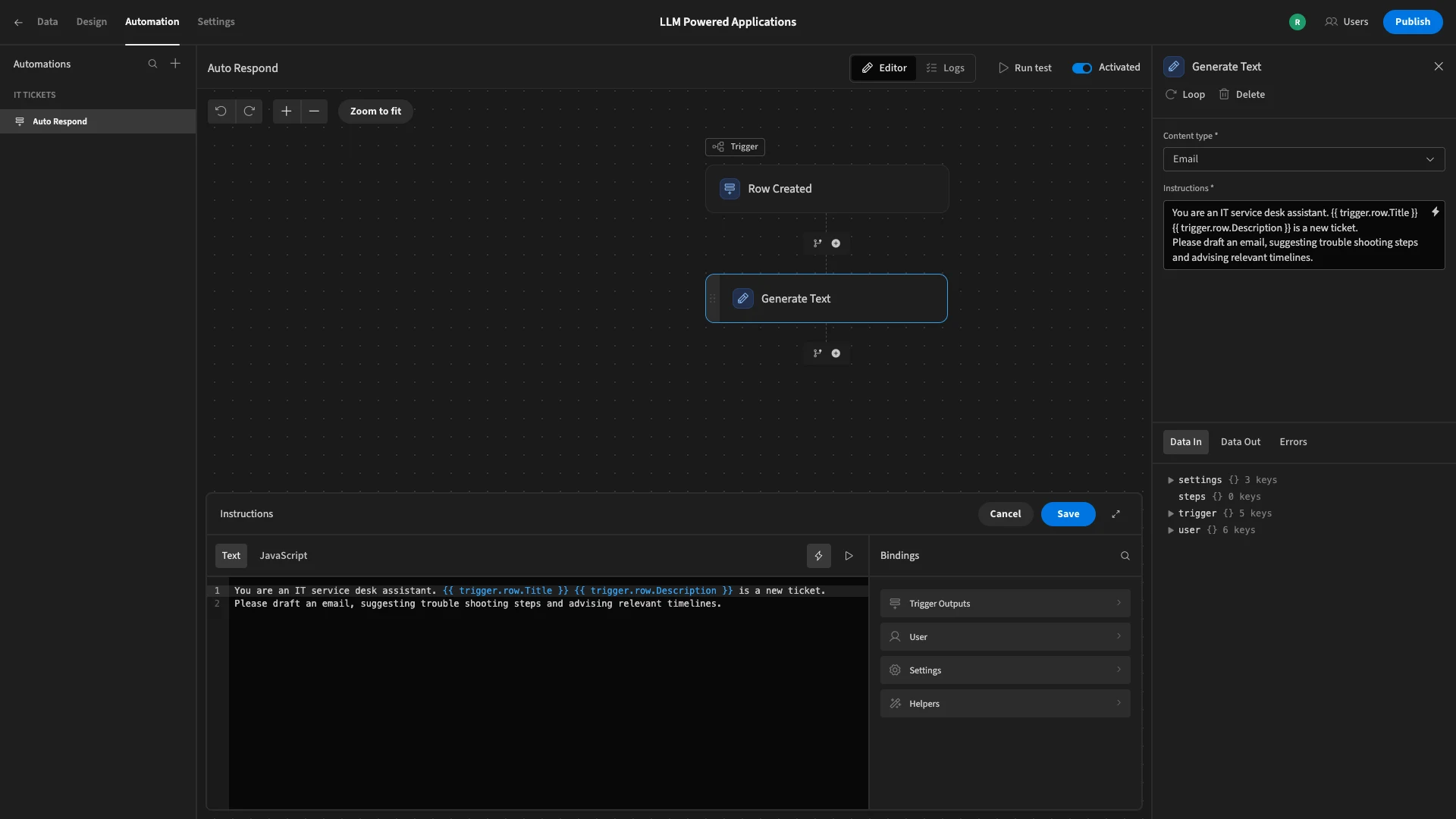
We鈥檙e going to add a Generate Text action. Under Content Type, we鈥檙e choosing Email.
We鈥檒l then hit the lightning bolt icon to open the bindings drawer.
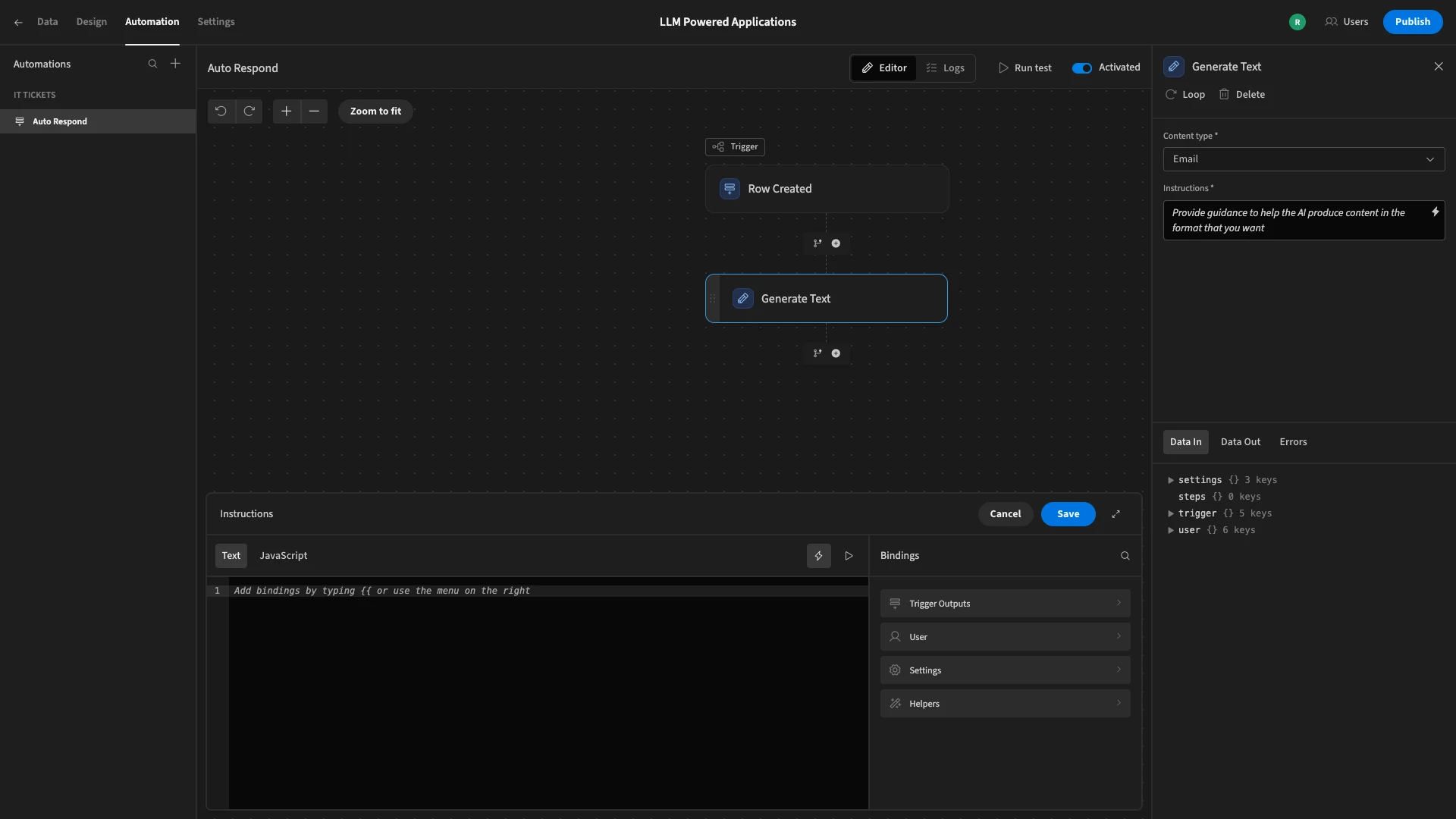
We鈥檙e going to use the following prompt:
You are an IT service desk assistant. {{ trigger.row.Title }} {{ trigger.row.Description }} is a new ticket.

Please draft an email, suggesting troubleshooting steps and advising relevant timelines.
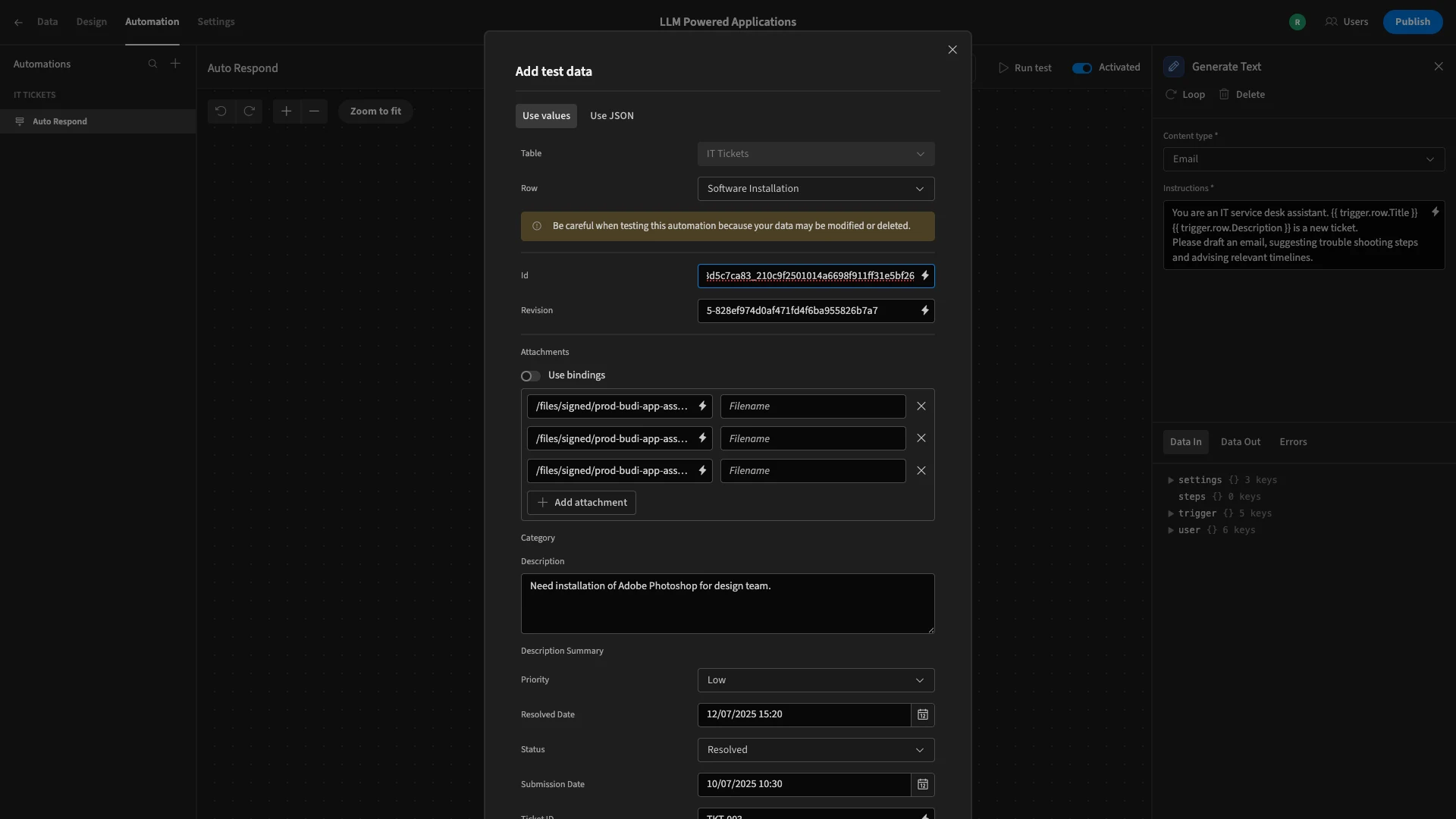
We鈥檒l then run a test, using a row that we know has its Priority set to Low.
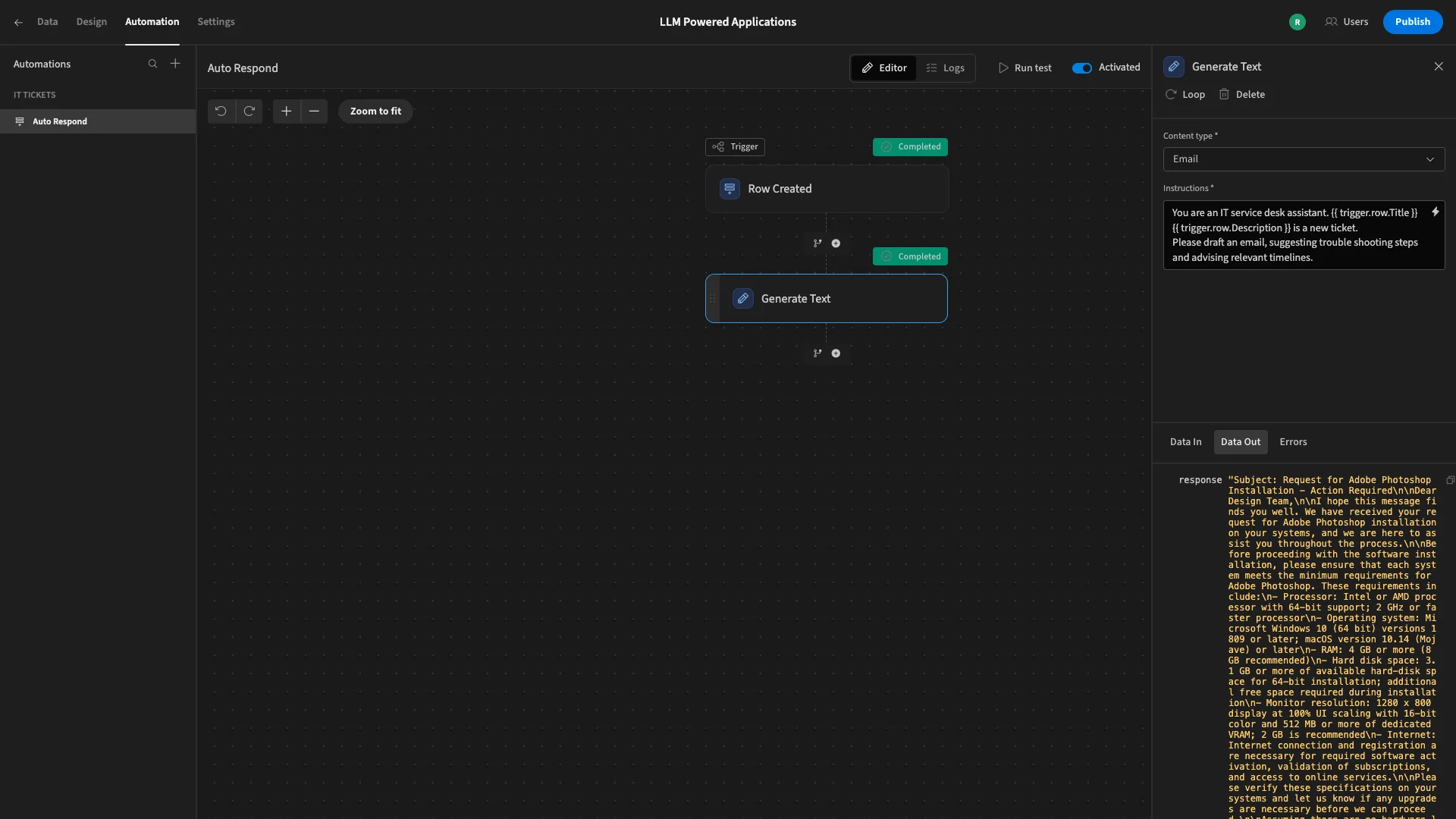
Under Data Out for our Generate Text action, we can see that this has worked.
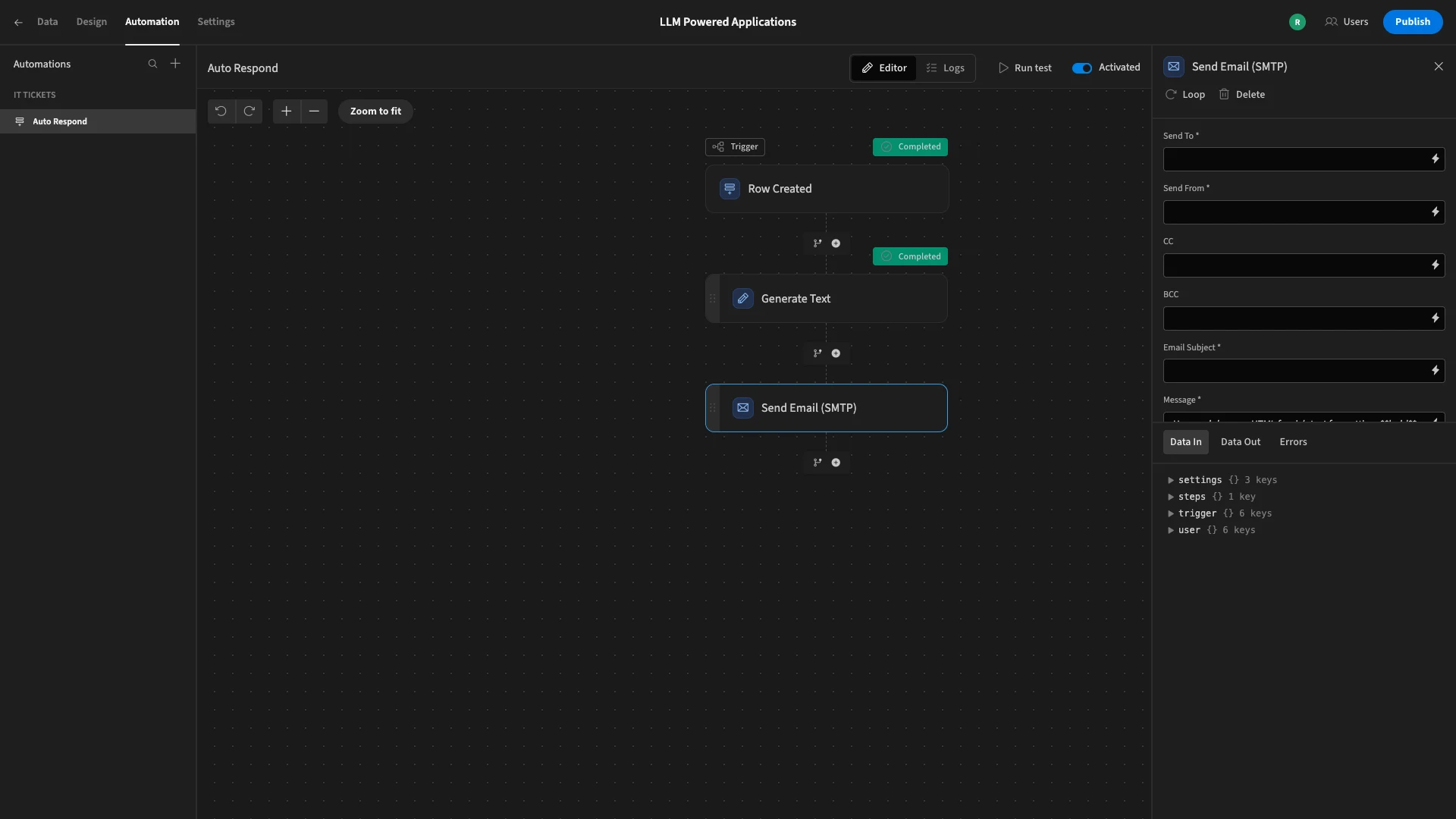
Lastly, we can add a Send Email step to use our response to notify users that their ticket has been received. Alternatively, we could use a HTTP request to send this to an instant messaging platform.
Turn data into action with 91制片厂
91制片厂 is the open-source, low-code platform that empowers IT teams to turn data into action.
With extensive data support, autogenerated UIs, powerful automations, comprehensive AI capabilities, custom RBAC, free SSO, and optional self-hosting, there鈥檚 never been a better way to build professional, LLM-powered applications.
Check out our features overview to learn more.